
Boat Trips, Fishing, Shopping,Events, Art Gallery … and much more
The History of Clevedon Pier
The building of Britain’s seaside piers was a direct legacy of the industrial revolution. The fruits of that revolution, often harshly exacted and only slowly shared, were wealth and leisure and new demands for entertainment and travel.
Almost every pier of note around the coast of Britain, seventy-eight all told, were built between 1854 and 1904. During this time there was also a rise and expansion of the regional pleasure steamer fleets. However, the most important catalyst for the pier builders, was the arrival of the railways. Until the Severn Tunnel was opened in 1886, Brunel’s Great Western line from London to South Wales took the “Great Way Round” (via Swindon and Gloucester) – Clevedon’s closeness to the main line from London to Bristol and the South-West, and the opening of the branch line to Clevedon from Yatton in 1847 offered the exciting possibility of a faster route to South Wales by steamer from a pier at Clevedon.
A pier for Clevedon had been under consideration for some time and on a Wednesday in November 1866, a meeting took place at the Public Hall, Clevedon. A proposed scheme for a pier was accepted and The Clevedon Pier Company was formed, the board of directors made up of Sir Arthur Elton, Richard Godwin, Samuel Ransford and John Maynard. By July 1867 work had begun.
Elegance was important for the new pier but it also had to be strongly constructed for commercial use in a fairly exposed position. The actual construction work was entrusted to Hamilton’s Windsor Iron Works of Liverpool.
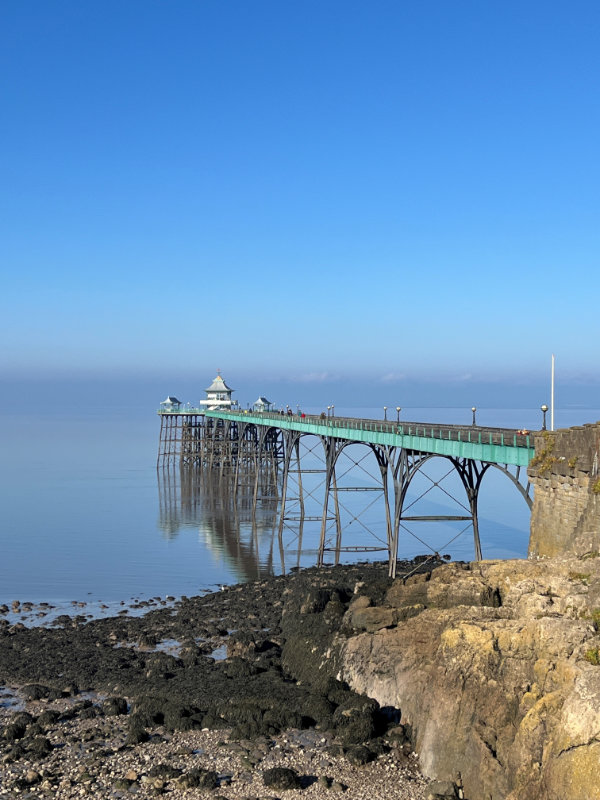
The contractors had been lucky to find some large quantities of Barlow rail, discarded from Brunel’s broad-gauge South Wales Railway. It may not have been successful as railway line, but it could be used to make superbly slender and strong supports for the pier. For almost two years, slowly diminishing stacks of the ironwork were stored along The Beach, Esplanade and Wellington Terrace. The construction of the pier was a very laborious task as every section of ironwork had to be manhandled before the crane could raise it into position. Approximately 370 tons of wrought ironwork were required. Gales regularly halted the work, but the structure held firm.
The construction of the abutments to the pier was not as hazardous as the pier itself. However, the design had changed from its original form and now included a Toll House, with accommodation for the Piermaster. The Toll House was built by Clevedon builder, W. Green, who was also responsible for building the bandstand further along the beach. It was designed by architect Hans Price of Weston-super-Mare, in a Scottish baronial style, much favoured at that time for bridge abutments. The romanticism of its design, contrasted strongly with the functional engineering of the pier. The entrance gates and railings were made in Clevedon in the foundry of Turner and Sons.
In all, the total cost of building the pier was £10,000 and employed an average workforce of sixty men. On the 6th February 1869, the contractors were able to hand the completed structure over to the Directors of the Pier Company.
The Collapse and Restoration
Disaster struck Clevedon pier on the morning of 17th October 1970, when under load testing, the two end spans failed and collapsed into the sea. Bernard Faraway, piermaster at the time, recalls:
“After the steamer season had finished, the biennial test for insurance purposes took place. The method was to fill heavy duty plastic containers with water. These were 50ft long, 5ft wide and 2ft deep, filled to a depth of 10 inches. This gave a pressure equal to 50lbs per square foot. Eighteen containers were used, six for each span, and three spans were tested at a time, starting from the Toll House end of the pier. Each test lasted three hours and after the first test No. 1 span had passed. The six bags used on no. 1 span were emptied, dragged over the full bags to No. 4 span and then refilled. After a further three hours, No. 2 span had passed, and so on. No. 7 span collapsed (bringing down No. 8 also). The tests had been carried out under full supervision. The cause of the collapse was undoubtedly a weakness in the seventh span.”
The collapse of Clevedon pier made headline news, not just locally but nationally.
Financial breakthrough
In 1984, after visiting the pier and seeing the progress that had been made, English Heritage made a grant of £500,000 and the National Heritage Memorial Fund gave an exactly matching sum. Woodspring District Council pledged their support with £170,000 while other smaller donations were given by the Pilgrim and Manifold Trusts.
The improved financial picture encouraged Woodspring to lease the pier to the Trustees for 99 years.
Final re-opening 1998
When the pier re-opened in May 1989, it was not completely finished. The landing stage and steps leading down to it were complete so regular boat trips could run, but the remaining works to the pierhead had not yet commenced. If you visited the pier at this time, you would be met at the end by a large metal fence, preventing you from walking onto the pierhead.
Great efforts were made to raise the remainder of the funds required to enable the pierhead to be fully restored and the Pagoda building and two shelters to be re-built.
In 1995 a further award from the Heritage Lottery Fund allowed the restoration of the landing stage, Pagoda building and two shelters to be completed.
On 23rd May 1998, Clevedon pier was formally re-opened by Sir Charles Elton Bart and Clevedon Bowler David Bryant. Sir Charles Elton is the great-great grandson of the original chairman of the Clevedon Pier Company.
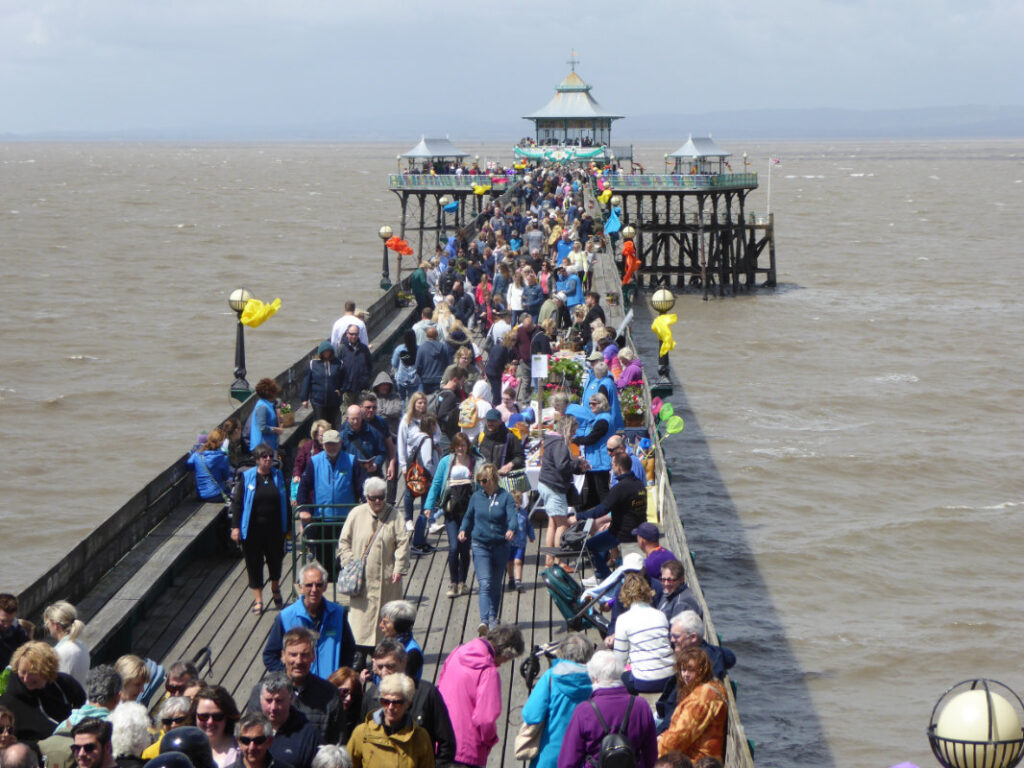
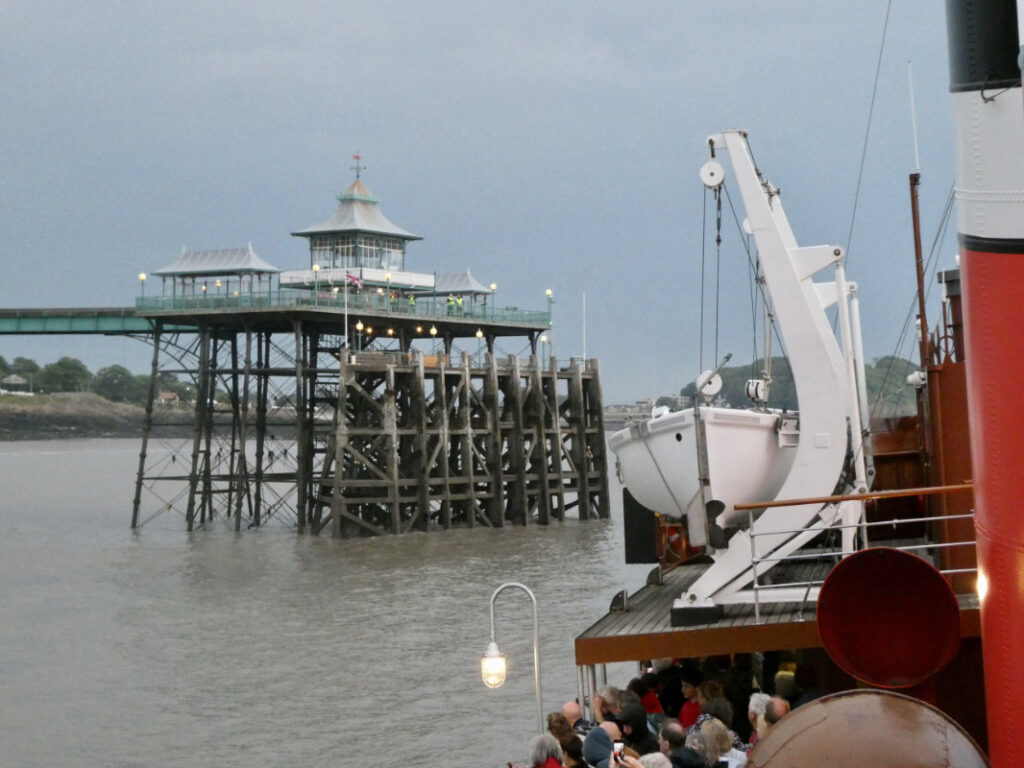
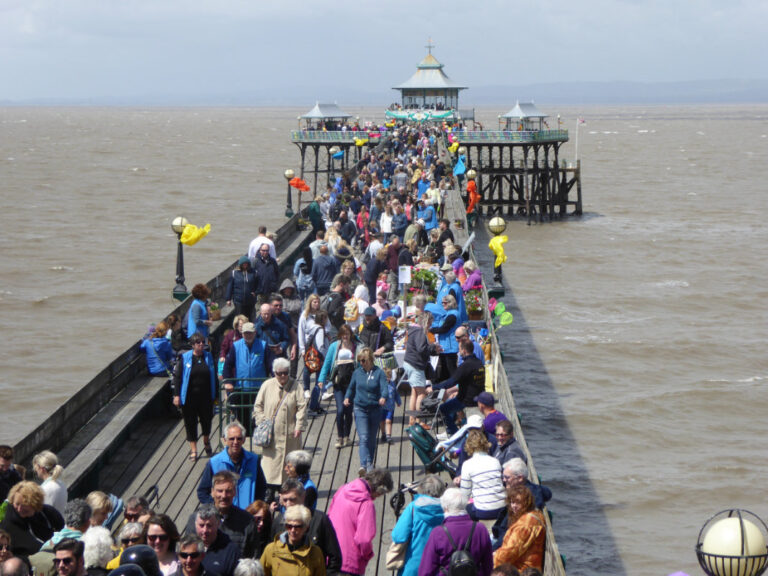
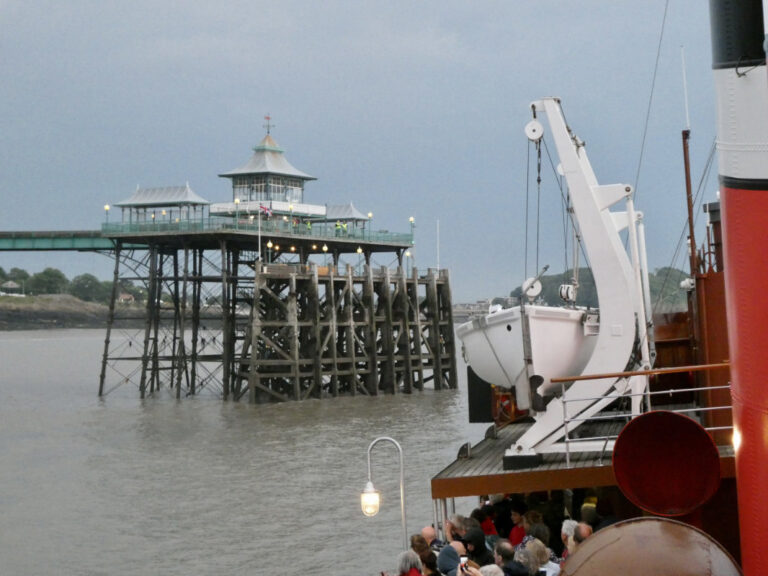
Thousands of people came to witness the occasion, again many dressed in Victorian period costume. The celebrations included the Royal Marine marching band, an air-sea rescue display, aerobatic display teams, ‘wing-walking’ and trips on the paddle steamer Waverley. Local Clevedon company, Firemagic, finished the day with an amazing display of fireworks using the whole length of the pier.
Boat Trips
Fishing
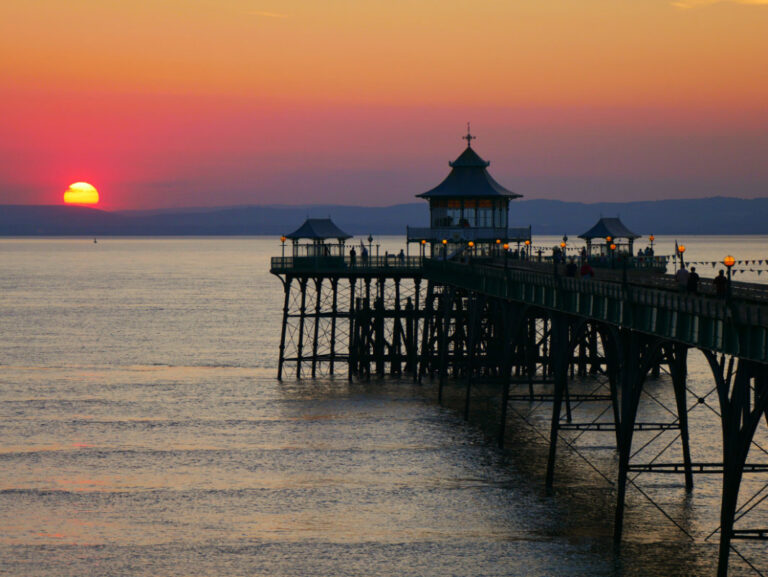
Come and relax whilst fishing from the only Grade 1 listed pier in the UK, with stunning views of the Bristol Channel and across to Wales.
The use of tripods is not allowed on the pier.