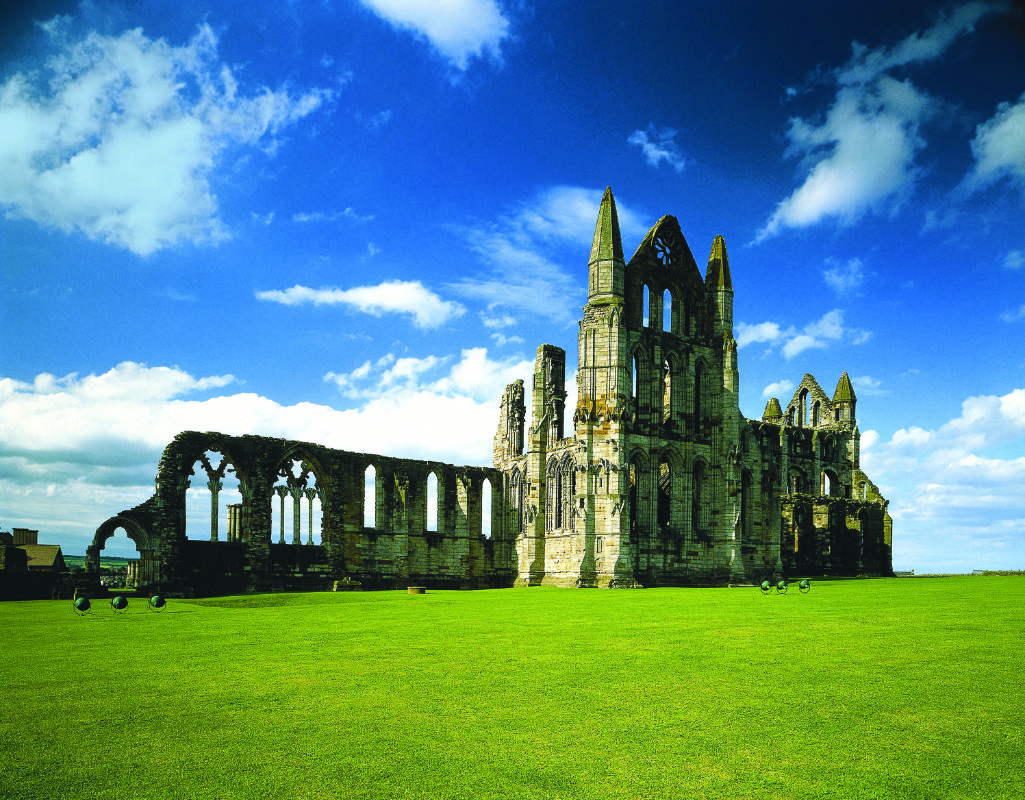
Perched high on a cliff, it’s easy to see why the haunting remains of Whitby Abbey were inspiration for Bram Stoker’s gothic tale of ‘Dracula’. Sink your teeth into years of history, amazing views and a packed events programme, just a short climb away from the picturesque Yorkshire seaside town of Whitby.
Founded in the 7th century, Whitby Abbey was one of the most important religious centres in the Anglo-Saxon world. In 664 it was the setting for the Synod of Whitby, a landmark in the history of the Church in England. It was here that the rivalry between the two strands of Christianity in England, the Hiberno-Scottish and the Roman, came to a head. Christianity had been brought to Northumbria not only by missionaries from Rome but by Irish missionaries from Iona in Scotland. The two traditions differed over such issues as how priests and monks should wear their hair and, most significantly, how the date of Easter should be calculated. Gathering the two sides at Whitby Abbey, King Oswiu heard both arguments and decided that the Roman side should prevail. England forged strong religious and cultural links with mainland Europe and the papacy in Rome that endured until the Reformation of Henry VIII when the magnificent later medieval monastery was reduced to ruins. The method of calculating Easter – as decided at Whitby – is still used to this day.
Whitby Abbey has also provided inspiration for many notable artists and authors including Cædmon, the first named poet in the English language, JMW Turner, and Bram Stoker, whose 1890 visit to the town and abbey inspired his most famous work, Dracula. The novel’s publication in 1897 gave Whitby a major literary association, ensuring that the sinister count would forever be linked with the seaside town.
In 2019 a re-interpretation project was completed at Whitby Abbey and now includes a new museum and new interpretation around the historic site. Visitors are offered a specially-designed hand-held interactive in the shape of an ammonite fossil which comes to life as they walk over lost abbey buildings, flashing colour-coded lights as it reaches certain points in the grounds where artefacts, now in the museum, were found.
The museum tells the story of Whitby Abbey, from the Bronze Age to today, and features a rare and internationally significant collection. It explores the history of settlement on the exposed Whitby headland, the spiritual significance of the site and how generations of writers have found inspiration in the dramatic landscape and wind-swept ruins. Key artefacts include imposing Anglo-Saxon free-standing crosses, intricately worked metal-work that speak of the international connections of St Hild’s monastery, finely carved stonework from the later Benedictine Abbey, and a signed edition of Bram Stoker’s Dracula, arguably the most famous horror novel in the English language.
Sorry, no records were found. Please adjust your search criteria and try again.
Sorry, unable to load the Maps API.